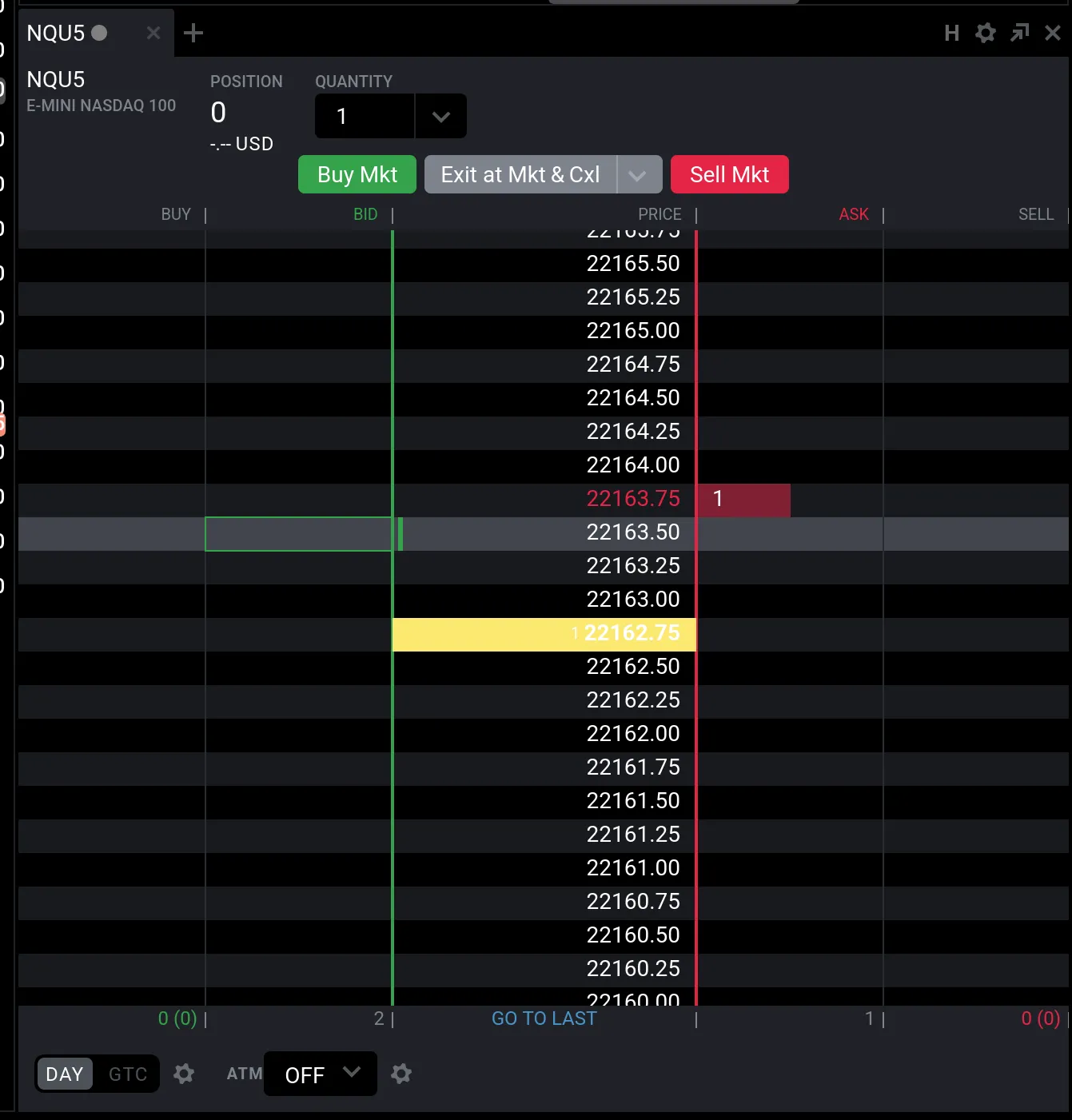
The order book is the instrument that drives a financial market. It basically is the record of all currently
working buy and sell orders at any given time.
A maker refers to a person who has a working order in the order book. The taker is the person
that executes that order by buying or selling at the price specified. This pair is referred to as a party and
the counter-party.
how orders drive the market
If you’re a retail trader, you might think that there are 3 main types of orders. But in actuality, there are
only two types of orders: market and limit orders.
Limit orders are simple to understand. You place an order at a specific price. The order will
only be filled at or better than that price.
Market orders are even better to understand. Buy orders execute on the lowest working sell order and
sell orders execute on the highest working buy order.
Stop orders are basically market orders in disguise. The mechanism of a stop order
never goes into the order book. Stop orders are acted on by the broker when the price falls to a
specific level, where a market order is executed at that price.
how liquidity drives the market
Liquidity is the primary driving factor behind the movement of price in a financial market.
Liquidity is defined as the ease in which one can enter and exit a position
without affecting the price.
The primary liquidity provider in most financial markets come in the form of working orders.
Logically speaking, if there are more orders at a price, there needs to be more executions at that
price in order to move the market. More executions to move = more liquidity.
We can also use language such as resting liquidity to refer to “dormant” limit orders and
aggressive liquidity to refer to market orders that “take out” the resting liquidity.
~~Depth of Market (DOM) is a common tool used to visualize the order book.
smart money theory
Smart money refers to the big institutional traders. Think banks and hedge funds that have
hundreds of billions. Whenever they want to enter long, they can’t simply press “Buy” because
that would explode their average order price (and their subsequent total loss) into the moon.
They have to look for areas with more liquidity so that they can actually enter with a good fill price.
part 2: stop hunts
Stop hunts refers to a trading strategy where smart money moves the market to an area with
pending stop orders to create enough liquidity.
This definition is also wrong.
the mechanism of stop hunts
The idea behind a stop hunt is correct. Institutional traders need to create liquidity for
themselves, so they do so by sending price to an area with a lot of pending orders.
However, there are main distinctions to be made from the commonly accepted definition, and that comes with
understanding how institutions enter trades.
Specifically, those institutional traders place several limit orders to enter their trade,
and similar orders to exit.
So the liquidity that stop hunts are going for isn’t the retail trader stop orders, it’s the institutions’
own resting liquidity, and other traders act as the aggressive liquidity that fill those orders.
The smart money isn’t sweeping liquidity, they are the liquidity.
Notably, the primary aggressive liquidity is other institutions, primarily high frequency trading firms.
day trading ~ fighting the bank??
This is something I hear A LOT. But you, as a retail trader, should never be trying to against the bank.
You’re never going to win.
And guess what? The bank doesn’t care about you either. You fill a percentage of their order so small
that it’s basically a rounding error. The banks are basically fighting against other banks.
With that in mind, YOU, the humble “little-guy” retail trader, gets to decide whether you want
to be WITH the banks or AGAINST the banks.
I don’t know about you, but the former sounds a lot better for my bank account.